In 1989, I saw a vision of the future. Energy from household rubbish. Weather forecasts accurate to the second. Clothes that adjusted to fit. And, Great Scott! There were flying cars.
The far future of 2015 looked pretty bright.
Earlier in the 1980s, another picture had been offered. Dark, monolithic buildings dominated the skyline. Los Angeles was drenched in rain. Space had been explored and exploited, and human-made beings were treated as disposable labour, hunted down when they tried to escape.
A much bleaker vision. This time, the distant future was 2019.
But once again, there were flying cars.
Now, in 2026, neither version of the future has arrived. Our everyday flying-car future seems to have vanished, like tears in the rain.
The reality of the 2010s was neither the bright future of Back to the Future Part II nor the dystopia of Blade Runner. Some details feel familiar. Others missed entirely. We accept this when it comes to fiction. The story gives us a future to explore, not one we expect to arrive exactly as written. We are not always so comfortable making that distinction when we look at our strategies.
A strategy often describes a positive future: a version of events in which a lot of important things have gone right. That can be useful. It gives people something to work towards. The problem begins when we treat that imagined future as a reliable description of what will happen.
Without too much effort, we can also imagine an anti-vision: a future in which the things we care about have gone badly wrong. It may be just as vivid as the vision, but neither picture tells us how likely it is.
And both are limited by our imagination. The future will include things we have not considered, for better and for worse.
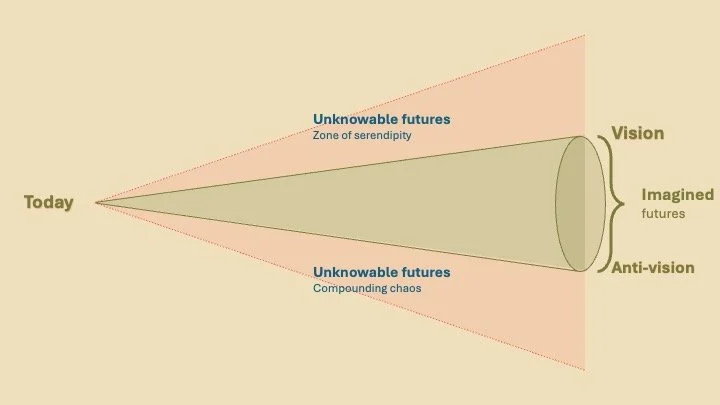
All possible futures start from today
Strategy will not work in isolation
Following the pandemic, I worked on a piece of intergenerational strategy in New Zealand’s environmental sector. Working across that timescale brought the limits of prediction into focus. Our tools could help us explore possibilities, but they could not give us a dependable account of what would happen over several decades.
Every possibility opened another question. “But what if?” Useful at first. Eventually overwhelming.
The answer was not to stop thinking about the future. It was to recognise that anticipating what might happen was only part of the capability the organisation needed.
Alongside the ability to make informed judgements about what could come next, it needed the capability to respond to what actually emerged. That capability cannot sit only around the governance table. It needs time, attention, and resources throughout the organisation.
People delivering the work need to understand its strategic intent. They need to be able to notice when conditions change, explain what that means for delivery, and help decide what needs to happen next. Sometimes that will mean changing the sequence of work. Sometimes it will mean reallocating resources, trying a different approach, or stopping something that no longer serves its purpose.
The direction still matters. But the work of pursuing it needs to respond to the world the organisation is actually operating in.
Accepting the ambiguity
The future is unclear. Our strategies need to work with that uncertainty rather than pretend it away. This does not mean we should stop designing strategy. It means being more deliberate about what our strategic tools are helping us do. Some things are ours to decide: our chosen direction, our priorities, and the commitments we make next. Other things we can influence: the relationships, capabilities, and conditions that make a positive future more possible. And some things we need to remain aware of: emerging technologies, shifting expectations, environmental changes, and signals that challenge our assumptions.
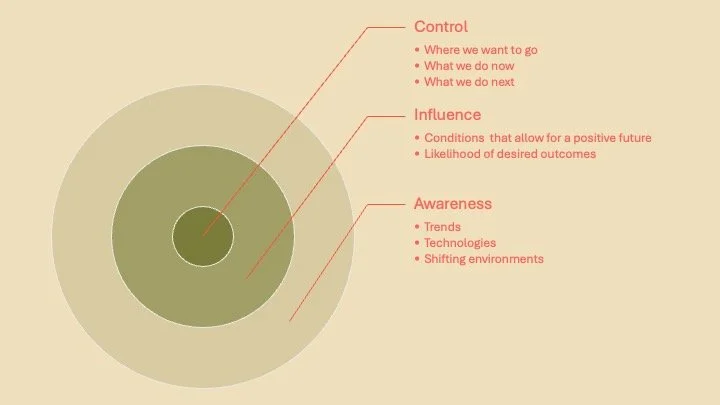
These are not three separate exercises. What we notice should inform what we try to influence—and what we decide to do next. This is where strategy becomes more than an imagined future. It becomes a way of making decisions as the future unfolds.
The work of leading strategy is not to promise that the vision will arrive exactly as described. It is to create the conditions for a better future, help people recognise what is changing, and keep making purposeful choices.
Even if, despite our best efforts, that future never quite gets around to the flying cars
