Who's who in the zoo?
Maturity model part 7
Next time you are in a meeting, take a moment and ask:
“Who’s our we?”
If you say it a few times in a row, quickly enough, there is a good chance someone will look at you as though you have gone mad.
But “Who’s our we?” is one of the most useful questions an organisation can ask when it is changing how work gets done.
It was also one of the most important questions in the first major piece of work I did using the maturity model.
The maturity model came from a need.
We had recently restructured around 500 roles. This was genuinely an effectiveness exercise, not a euphemism for getting rid of jobs. Most people were deployed into new team structures and many had new reporting lines.
That left us with a challenge.
The operating model had been broken apart and reconnected. The systems that made up that model were, unsurprisingly, in disarray. Some still worked, and the organisation could continue to deliver services. But across the board, many systems were operating at Level 1 or Level 2. The new operating model had not begun with consistency.
That mattered because the point of the restructure was to create a more joined-up organisation. The point was to be more consistent.
In the days and weeks around go-live, teams were disjointed and there was little clarity about who “we” meant. When people used the word in conversation, it could mean:
“We” as my old team from before the restructure.
“We” as my new team, but only my immediate team.
“We” as the former specialist group I belonged to.
“We” as the new directorate.
“We” as the new group.
In other words, “we” could be translated in many different ways. It had all the makings of a heavily siloed organisation.
To deliver the required change, we needed to bring the operating-model systems together. We also needed an intentional, shared understanding of who was included when we said “we”.
“We” changes with maturity
A maturity approach considers the capability of an organisation, not simply the competence of an individual. That means the group a system applies to expands as maturity increases.
Put simply: as a system matures, its “we” gets bigger.
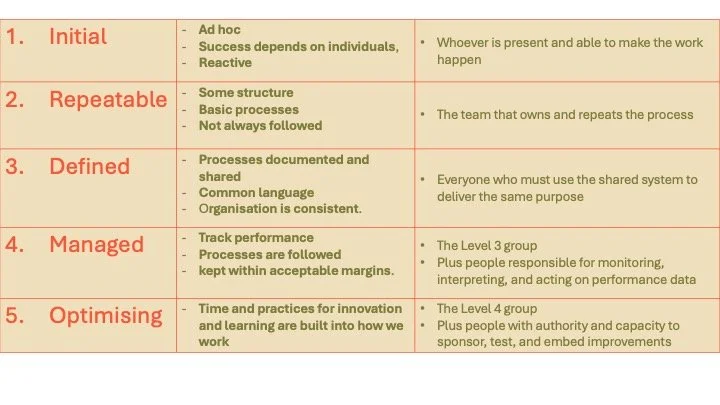
As “we” mature who “we” are changes.
As the ‘we’ gets bigger, the work of system maturity gets harder. A Level 1 system can survive on individual judgement. A Level 3 system requires shared language, training, trust, and a willingness to give up some local variation. A Level 5 system requires people with authority to make investment decisions and a culture willing to learn from change.
“We” matters when thinking about where we are going.
There was a lightbulb moment for me when working with an evaluation team. The team was made up of evaluation specialists: a tight-knit, high-performing unit. They looked at the maturity model and quickly developed a rubric to assess their evaluation system across Levels 1 to 5.
As a newly established team, they recognised that they first needed to develop standard operating procedures and capture repeatable processes. They assessed the system’s current state as Level 1. The conversation then moved to the maturity level they wanted in the future.
As passionate and highly skilled professionals, their immediate instinct was Level 5:
“We want to keep up with modern practices and integrate them into our work in a meaningful and ongoing way.”
But they also recognised that this would require a more senior decision. The time and cost needed to continually keep up to date and embed new approaches would be valuable to the team, but it would also carry an opportunity cost for the organisation.
They then considered Level 4:
“We want to ensure the evaluation methods we design are used consistently and within the boundaries that make them effective and robust.”
When we broadened the conversation and asked who would use the evaluation system, and what they needed from it, the organisational requirement was simpler:
Evaluation should be carried out consistently across the organisation. That pointed to a Level 3 future state.
The three possible futures were not competing definitions of success. They reflected three different answers to the question: “Who is our we?”
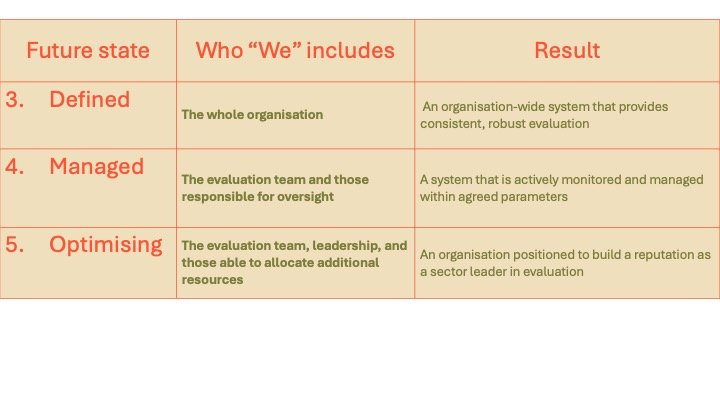
Design enough maturity to meet your needs.
By understanding who each system was for, what future state we were seeking, and how much maturity was required in different parts of the organisation, we were better placed to make decisions and plan the allocation of resources.
More importantly, being intentional about the “we” in our systems work created greater clarity about whose work belonged to whom. It helped slow the formation of some of the silos that might otherwise have hardened after the restructure.
The final maturity target still needed to be decided. But the team did not need to wait for that decision before acting. Every future state required the system to move through Level 2. Capturing the work, developing repeatable processes, and building a team-owned way of working was the work to do next regardless of the final state so the team was able to start on delivering the strategy straight away.
