Taking a flexible approach dosen’t always work.
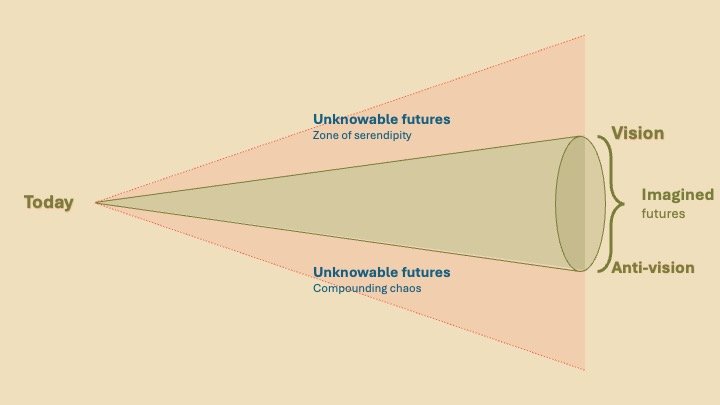
I was talking with a senior leader about the need to implement a more adaptive approach to strategy. About how a strategy paper wasn’t what was needed what was needed was a flexible framework that took into account the range of possible futures. We had gone over the cone of possibilities:talked obout how certinty shrinks and the number of possible futures expands as we look further ahead.
We spoke about setting things up to move towards the futures we wanted and away from the ones we hoped to avoid. and how beyond the imaginable future there sits the things we had not imagined at all.
ther reponse I got was something along the lines of:
“I get it. But my team won’t. They just need us to give them certainty, even if it isn’t real.”
That stayed with me.
Not because I didn’t understand the attraction. Giving people a clear answer feels good. Being able to explain where we are going and how we will get there is a reassuring part of leadership.
But what struck me was the choice being made. A comforting story was being offered in place of a difficult truth. The uncertainty had not gone anywhere. The people expected to deliver the strategy were simply not being invited into an honest conversation about it. Instead they were grouped into a homogionous group and labled with a big old “can’t handle the truth” sticker.
I think they deserved better, I think they deserved that conversation.
The comfort is the attraction
This is what I mean by the sirens of strategy.
They offer us the comfort of knowing the unknowable. A clear pathway to the destination. A convincing sequence of events. A confidence that the work stops once the document that has been reviewed, refined, and signed off.
None of those things is inherently bad. they are a part of the picture.The trouble starts when small parts of the process step in as proxy evidence for a level of certinty that doesn’t exist.
Whats frustrating about this is that, accepting that I could not know the future had almost the opposite effect to the one that leader feared. It freed me up. to become much more effective at delivering strategy.
I could stop trying to make the future sufficiently predictable and spend more time on what I could know and do. What was happening now? What capability did the organisation have? What needed attention? What could we influence? What was the next useful piece of work?
There was still uncertainty. There always would be, but there was also work to get on with.
The sirens pull us in the other direction. They invite us to make comfortable substitutions. and they steel our time, because when we are drawn in to by the sirens of strategy, it is only a matter of time before the reality promised is shown to be just an illusion, and we have to start the whole journey again, with that call of predictability ringing in our ears.
Siren 1: Awareness feels like control
Knowing about something does not mean we can direct it. It does not even guarantee we can influence it.
We can have good evidence, understand the risks, and put the issue on every agenda without gaining the ability to make it behave as we would like.
Climate change is a large and uncomfortable example. Having evidence about the problem does not settle the decisions that follow. Even an economic advantage does not automatically determine action: IRENA’s analysis found that 91% of new utility-scale renewable capacity commissioned in 2024 produced electricity more cheaply than the cheapest new fossil-fuel alternative, while also identifying financing, permitting, and grid-integration barriers.irena
Knowing matters. But knowing is not the same as being able to make the outcome happen.
The organisational version can be much smaller. A risk appears in a register. A dashboard tracks a trend. A report goes to governance.
All useful, potentially. But the question remains: what can we actually do about it?
Awareness should inform our choices. It should not reassure us that the situation is under control simply because we can describe it.
Siren 2: “It could” feels like“it will”
I see this particularly in long-term planing.
If we secure the funding in year one, deliver the project in year two, and have the widget in place by year three, it will change what we can deliver in years four to nine.
That might be a sensible pathway. It might be worth investing in. the logic is clear and it holds that “this” follows “that”
But somewhere between developing the pathway and approving the plan, the “ifs” can quietly disappear.
We will receive the funding. We will deliver the project. The widget will work. The conditions that made it useful will still apply when it arrives.
What began as a possibility becomes an expectation, then a commitment.
The plan becomes easier to explain. The future has not become any more certain.
The work is not to avoid making commitments. It is to keep the assumptions visible and be clear about what happens if they do not hold.
What would we need to notice? Which decision would change? What other route might still serve the purpose?
A pathway is useful. Mistaking it for a promise from the future is not.
Siren 3: Success feels like following their rules
Another comforting shortcut is to let someone else define success.
There are familiar measures, established comparisons, and accepted ways of showing that an organisation is doing well. Following them saves us a difficult conversation about what we actually value.
Bhutan offers a useful counterpoint. Its Gross National Happiness framework broadens the assessment of progress beyond economic output to include matters such as health, community vitality, culture, governance, and ecological resilience. It complements GDP rather than making economic information irrelevant.sdgs.un+1
The point is not that every organisation should adopt Bhutan’s framework. It is that an established definition of success is still a choice.
In strategy work, that means asking whose version of “good” we are pursuing.
A sector benchmark might be useful. A funder’s expectations might be important. A familiar performance measure might tell us something valuable.
But none of them removes our responsibility to decide what success means for the purpose we are here to serve.
Borrowing the measure is easy. Checking that it represents what matters is the work.
Siren 4: “Document sent” feels like “job done”
There is a lovely moment when the strategy is finished.
The feedback has been worked through. Governance has approved it. The document has gone out. Perhaps there is even a nicely printed version.
We should be allowed to enjoy that moment. It can represent a great deal of thinking and effort.
But the document being finished does not mean the organisation is ready to deliver it.
People still need to understand what it means for their work. Systems may need to change. Decisions need owners. Capability, trust, time, and resources may need to be built.
Those are the hidden yeses inside the strategy.
If strategic attention ends when the document is sent, we have completed the description of the work and mistaken it for the work itself.
Siren 5: A “distant future” feels like we “start work later”
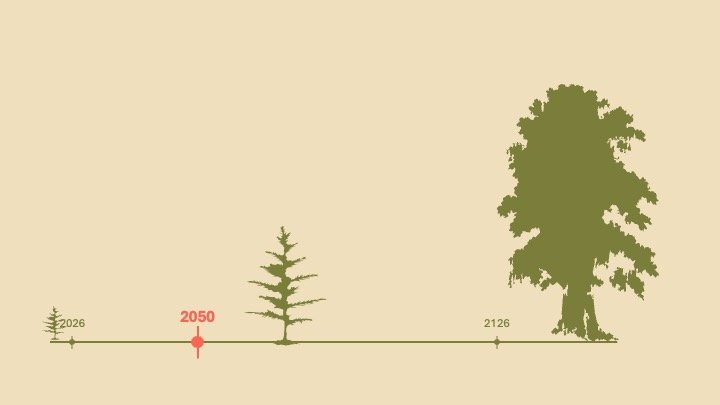
A strategy looking towards 2050 can make the future feel comfortably far away.
Plenty of time.
But some of the conditions needed for that future will take years to create. Relationships need time. Capability needs practice. Trust needs experience. Systems need to develop.
The distance to the outcome does not tell us how long we can wait before beginning.
The useful question is not only, “What do we want to be true in 2050?”
It is, “What needs to start now for that future to remain possible?”
Sometimes the answer will be a small commitment. Sometimes it will be stopping something that is taking us in the wrong direction.
Either way, a long horizon is not permission to postpone the work. Plant the tree whose shade you will never sit under.
Confidence without pretending
I understand why these sirens are attractive.
Saying “I don’t know” can feel like a confession that you are not doing your job. If people are looking to you for leadership, uncertainty can feel like the last thing you should offer.
But I think we have a moral obligation to treat people with more respect than that.
Respect includes being honest when the answer is not known. It includes recognising that people can participate in difficult conversations, not just receive reassuring conclusions.
That does not mean dropping uncertainty into people’s laps and walking away.
“I don’t know” is the beginning of a leadership conversation, not the end of one.
We can explain what we do know. We can make the purpose clear, agree what happens next, and identify the decisions that will need revisiting. We can give people the authority and support to respond as things change.
We can also build an environment where trying something new does not depend on pretending it cannot go wrong. Mistakes will happen. The responsibility is to take appropriate care, notice what happens, learn, and respond—not to promise that every attempt will succeed.
The confidence I want to offer is not, “Everything will happen as we planned.”
It is, “We have the skills (or we are prepared to build the the skills) to work through what comes next.”
That is a different kind of reassurance. It asks more of leadership, because it needs to be backed by something real.
The next time strategy makes us feel too excited or too comfortable, perhaps it is worth pausing to ask:
Is that confidence coming from our ability to respond, or from a story that lets us pretend we will not need to?
