It’s not an attack, it’s an observation
Maturity Models Part 1.
If you’re like me, when you read the title of this blog, you may have felt a hint of defensiveness. Weird, right? Not from you, from me. I wrote it.
But that reaction is often the first hurdle I need to get past when I introduce the idea of capability and maturity models to teams.
Feeling a little defensive makes sense. Introduce a capability maturity model and the first response is likely to be: Why are you interested in my capability or maturity?
To be perfectly honest, I often introduce the idea in a way that avoids the me needing the sentiment, “It’s not an attack; it’s an observation.” But you are here, reading this blog, so perhaps the title has some merit.
I have been using this simple one-to-five scale for the last few years, and I have been amazed by its depth, versatility, and what emerges when people use it. So far, it has worked as:
A diagnostic tool
A decision-making aid
A planning kit
A coaching tool
A way to improve team morale
A way to design and build the kind of organisation we all want to be part of
Big claims, sure. But let’s not start at the end. Let’s begin by explaining the basic idea behind the maturity model, because it sits at the heart of how I think about delivering an adaptive strategy.
Where it all began?
Necessity is the mother of invention, your weaknesses and your strengths are two sides of the same coin, the best time to plant a tree is 30 years ago, the next best time is today. All sayings that are intended to help, but if you find yourself staring down the barrel of a really knotty problem the only thing they uplift is the punchability of the person saying them. That is to say, my journey with this maturity model started with a really knotty problem. I was employed to develop a strategy for a regions environment in a regional government organisation that was transforming it’s entire way of delivering work. Every system was under review or new, teams were being seperated and set up, and our strategy needed to reflect the nature of the work (reforestation, flood infrastructure and climate adaptation) and be intergenerational. The governance changed at either a national or regional level every year and a half. And I refused to create a strategy that was a whole lot of good thinking but then needed someone else to create an implementation plan for. Strategy needs to be implementable, otherwise what’s the point?
So the time scale and challenges we were facing meant that the future was massively uncertain, the changes in governance meant that we had limited control, and the new operating model meant that our systems were often in their infancy. We needed a way to track how our systems were coming along, in order to deliver strategy and the new operating model. We chose a maturity model as a way to do this, and interesting things started to happen.
By applying a maturity lens to our operating model, across all of the major systems for delivering, enabling and improving work we realised that the maturity model could be a tool to prioritise and sequence change, to visualise the gap between current and desired state. And unlike other approaches to strategy, it didn’t presuppose a fixed pathway, rather it laid out all of the options for what next could be, on the path to where we want to be.
There wasn’t one solution to the knotty problem there were three critical elements all working together:
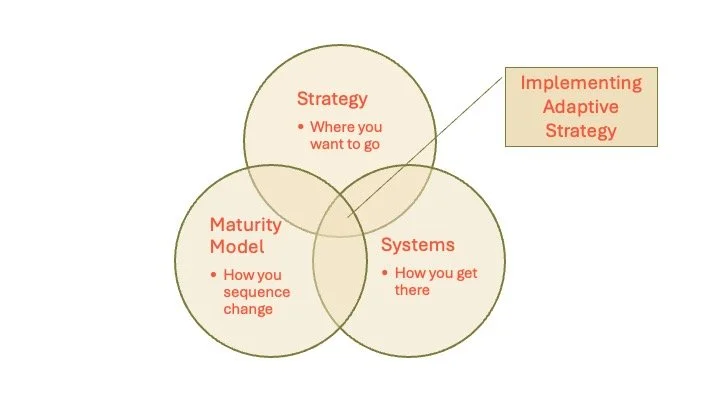
Strategy tells us where we want to go, our systems deliver that strategy, and a systems maturity model enables adaptive responsive to delivery of strategy
What is this Maturity Model?
The maturity model I use is a started with the Capability Maturity Model (CMM) tool, and evolved. By exploring stages the that both technical and social systems need to progress through to get to the point of optimising.
I started to uncover a whole range of organisational features that emerge, from more mature systems, as well as a wide range of conditions that need to be in place for before an uplift in maturity can happen. These include ideas like building trust for high performing teams, how to address silos, and how to prioritise change effectively. I will explore all of these ideas in the coming posts.
The maturity model I use lays out five layers of maturity for organisations (not for individuals), I use it to get a handle on how mature systems are; this helps me to understand how an organisation can adapt to deliver its strategy.
It goes like this:
Maturity models generic levels.
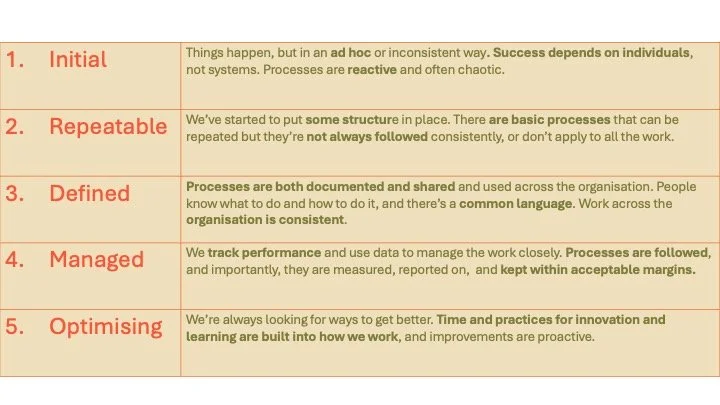
Maturity levels that can be applied across organisational systems.
This simple table has transformed how I approach strategy and systems work, not by attacking how work is done but buy giving me a better way to observe.
I will explain more in my next post.
