No such thing as bad weather
Maturity Models Part 2.
There is a Scandinavian saying I love:
“There is no such thing as bad weather, just bad clothing.”
It reminds me of wild adventures in the hills with Monty, my dog. It reminds me of that feeling of being out in the elements, wrapped up warm, when the warmth of your body feels sweeter because you can feel the cold on your cheeks.
I think there is a similar truth about organisational maturity: there is no such thing as a bad level of maturity. There may be levels you would prefer a team or system to be operating at, but every level has something to offer.
“Every maturity level is valuable” is the first principle I share when applying a maturity lens to organisational systems.
The question is not always, “How do we get to Level 5?” More often, it is: “What level of maturity is appropriate for this system, in this context, at this point in time?”
Value at each level of maturity
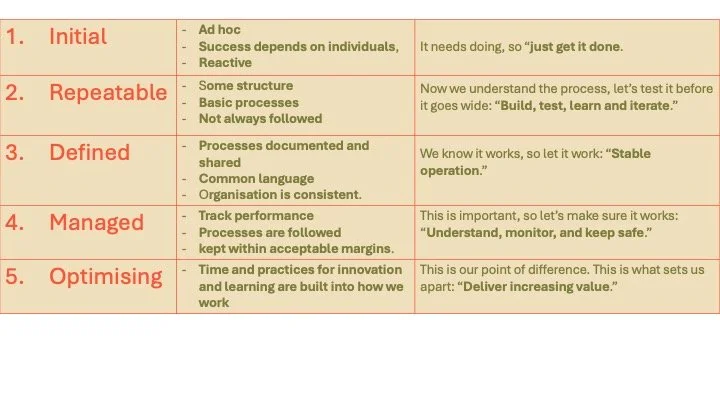
Each maturity level delivers value to an organisation
Surely not every level is valuable?
The idea that there is value at every level may sound a little naïve, particularly when we look at Levels 1 and 2. So I want to share two examples from my work where an initial or repeatable level of maturity has been more than enough.
1. Initial: Long-term planning
Local government in New Zealand produces a Long-Term Plan and updates it every three years. I have worked with many of the people who do this work over the years, and planners often want a more consistent system: something that smooths the planning process and can be rolled out every three years.
The current approach can feel ad hoc. Each cycle requires the planning team to develop an approach that responds to the moment, and there is a natural desire to create a more mature and repeatable system.
However, when we step back and look at the context of long-term planning, we see:
A local election between each Long-Term Plan cycle.
A national election between each cycle.
Changes in service delivery that reshape the operating environment.
Other shifts in the local-government context that may have a significant impact over three years.
Looked at this way, a system that prescribes a detailed approach to planning can become out of date after only one or two of planning cycles. The time and resources required to refine and mature that system may be better used ensuring that dependable people are in place to deliver the plan every three years.
In this context, an initial level of maturity is not necessarily a failure. It may be a sensible response to an environment where the conditions change significantly between cycles.
This does not mean the work should be chaotic. It means the system should rely on capable people, useful guardrails, and a fresh response to each planning cycle rather than expending effort on a rigid and heavily standardised process.
2. Repeatable: Recruitment
Recruitment is a function every organisation needs. In larger organisations, it carries significant direct and indirect costs: a slow process affects delivery, increases stress on staff, and can damage an organisation’s reputation with candidates.
As a result, I often see HR teams seek to lift the maturity of recruitment from Level 2, where the recruitment team delivers the process, to Level 3, where every line manager and person with direct reports can deliver the recruitment process.
The accepted wisdom is that the line manager is most directly affected by the recruitment decision and should therefore be most involved. However:
Recruitment processes are tightly bound by legal requirements.
Line managers are, by definition, under-resourced when they have a recruitment need.
Practice and repetition are often needed to become good at following a process.
If a line manager has a great deal of repetition in recruitment, it may signal that something is wrong, such as high turnover, a mismatch between expectations and reality, poor team culture, or poor leadership.
In this context, the recruitment process that creates the most long-term value may be a Level 2, repeatable process owned by the HR team. It can provide a reliable service to line managers, be run by people with specialist expertise, and support strong candidates into the right roles.
This approach also frees some of the line manager’s limited capacity to focus on their core work: leading their people and delivering results.
The value of Levels 3 to 5 is often easier to see. I will explore the value of Level 3 systems specifically in a later blog.
