Slow down, enjoy the view It’s going to be a journey
Maturity models, part 3:
Strategy work is the work of imagination. It is the work of creating a shared direction: a future in which today’s challenges have been addressed. It can be an intoxicating place to focus.
A positive vision of the future draws us in. It is a siren call for our attention, and it can leave us with a sense of disconnection when we return from that positive conceptual future and find ourselves still locked into the challenges we had wished away during strategic visioning.
Maturing our systems, becoming more efficient and effective in how we deliver work, is how we make the journey. It is how we close the gap between the future our strategy describes and where we are now.
This becomes clearer when we consider the second principle of the maturity model:
We have to spend time at each level of maturity before moving on.
The logic behind this principle is straightforward.
Maturity journey doesn’t skip steps
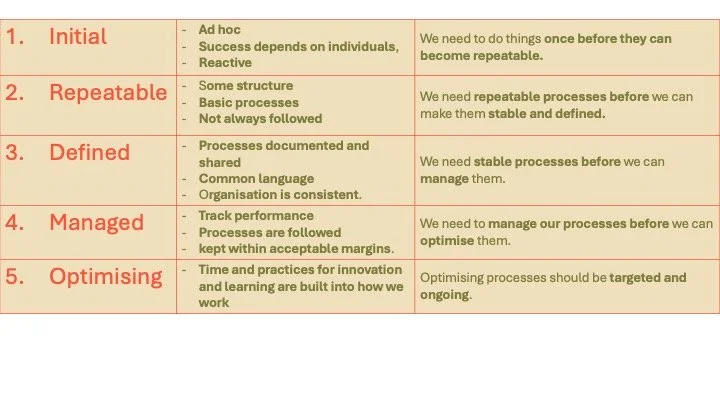
Maturity, a walk before you run approach
The more moving parts the more options for pathways forward
As we set a destination for our systems, a desired future state, it is important to recognise that there can be many iterations before we get there.
Each system can move through up to five levels of maturity. Across an organisation, systems will develop at different rates, and each combination of systems operating at different levels of maturity will have its own strengths, constraints, and opportunities.
The heart of adaptive strategy
This is where the maturity model becomes the beating heart of an adaptive strategy.
As an organisation evolves, its systems mature and interact in ways that reveal strengths and opportunities we could not necessarily see when setting strategic direction. At the same time, the operating environment changes. The competitive landscape can shift; technology can disrupt; economic conditions can interrupt plans; and environmental events can reshape what is possible.
By understanding where we are now through the lens of systems maturity, we have a practical tool for asking: Where to next?
Organisations have a limit to how much system change they can absorb at one time. Moving from one level of maturity to the next also takes time, because each level creates the foundation for what follows.
This creates an opportunity to adapt strategy as circumstances change. Rather than treating strategy as a fixed destination and system improvement as a separate operational exercise, organisations can use maturity to make deliberate, sequenced choices about what needs to change next, and what is not yet ready to change.
