I didn’t agree to that…did I?
Maturity Models Part 4:
Have you ever thought about the other yeses? The smaller things you say yes to when you say yes to a big thing? A few years ago, my wife suggested that we go to north Queensland and dive on the Great Barrier Reef. Of course I said yes. It was an amazing opportunity.
What I did not realise at the time was that I was also saying yes to facing a huge fear: the fear of being underwater and having to breathe.
It was a fear I did not know I had. But it turns out that there is something about using SCUBA equipment that touches a deep-down terror in me. Less than 20 cm below the surface, off the side of a boat in tropical Queensland, I found myself panicking. I was lucky. With some kind words from my wife and some practical words from the instructor, I was able to regulate with my regulator. I then got to SCUBA dive for the first time among some of the biggest and most beautiful coral in the world.
Saying yes to the holiday had also meant saying yes to terror; yes to facing a fear; yes to a once-in-a-lifetime experience; and yes to learning, once again, that my wife has always got my back.
Cool story, right? But what has that got to do with maturity models?
More than you might think.
The hidden yes is at the nub of why strategy is so hard to deliver. Every strategy contains hidden yeses: the unspoken commitments to change how we work.
In the previous post, I wrote about why we need to spend time at each level of maturity, and how delivering strategy is the journey of maturing systems. In this post, I want to introduce the next principle of using the maturity model to deliver strategy:
The work required to move up a level changes at every step.
This is the hidden yes we sign up to when we commit to a new strategy. We are saying yes to changing how work happens.
To do this, we need to ask two beautiful questions, which I first heard from Dr Ian MacDonald:
What is the work? And whose work is it?
Before we get to that, let’s look at how the work changes as each system matures.
The work of moving up
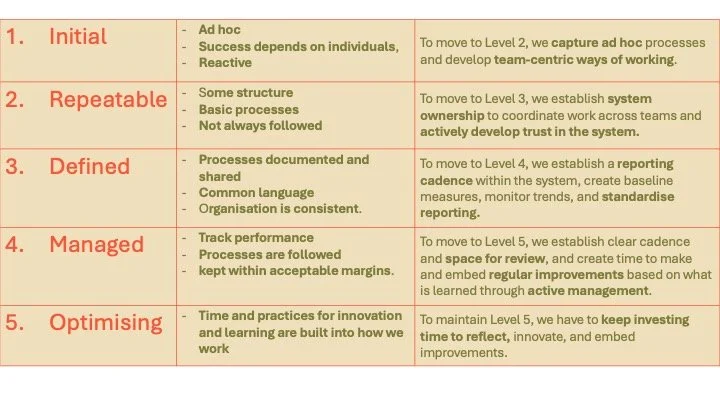
How we got here is not how we will get there.
These changes in work may appear simple, but I think they have profound implications for how we approach leadership in organisations. They are the difference between having a strategy that is inspiring but unrealised, and becoming an organisation that is strategic: able to adapt and continuously deliver outcomes aligned with its purpose.
All in all, the work of delivering strategy is the work of leadership, though perhaps not in the way we have been told. So, when you say yes to a new strategy, think about the hidden yeses. They are the work you will need to do next.
I will start to explore The implications on how and why we get stuck in the delivery of strategy in the next post.
