Moving at the speed of trust
Maturity Models Part 5:
I have rock climbed, on and off, for more than a quarter of a century. It is a place where I find peace, and it is a sport I have thought a lot about over the years. At the heart of climbing, perhaps more than in any other sport I have tried, is trust.
Trust in your fingers. Trust in your feet. Trust in the rope and harness. Trust in the equipment used to set up anchors. Trust in the rock to hold those anchors securely.
More than anything else, though, climbing is about trust in other people. Climbers will regularly meet someone at a crag and, within a very short time, literally trust them with their lives as a belayer.
Climbing has a culture of trust. That is one of the things I love about the climbing community.
Finding a culture of trust anywhere is special. If there is a culture of trust in your organisation, you are being paid to experience one of the best things you can be part of.
The trust threshold
In the previous post, I wrote about the hidden ‘yeses’ within any strategy: the commitments we make when we agree to change how work happens.
One of the most important of those commitments is the commitment to building trust.
Maturity requires us to change the work at each level in order to progress. As systems mature, the who, how, and why of trust change dramatically. This has significant implications for leadership, and I believe it is one of the most common sticking points for organisations trying to deliver their strategies.
As I have shared this model with organisations across sectors, sizes, and countries, one pattern emerges more than any other: most organisations want systems of Level 3 and above but find themselves stuff stuck with mostly Level 1 and Level 2 systems.
Some teams buck the trend. Finance and accounting often arrive with much of the discipline associated with Level 4 already built in at a sector level. Payroll, for example, is rarely approached in an ad hoc manner. The consequences of inconsistency are immediate, the numbers are clear, and the processes are often well established across organisations. When the barrier to entry includes audit processes and fastidious attention to numbers, it is not surprising that maturity sits relatively high within finance teams. This tends to be an exception rather than a rule, and I say that without judgement: every maturity level has value.
If I was to sum up what I see when delivering work on maturity models it is that; organisations want to operate at Levels 3, 4, and 5 while finding themselves unable to move beyond Levels 1 and 2.
Crossing the threshold
This becomes more difficult as an organisation grows, because moving from Level 2 to Level 3 requires crossing a trust threshold.
Part of reaching Level 3 is actively developing trust in a shared system. This means:
Staff across departments trust the system.
Staff across departments trust that others are using the same system.
Staff trust leadership to support, maintain, and improve the system.
Training in the system is trusted, consistent, and seen as worthwhile.
Essentially, if an organisation wants systems at Level 3 or above, its leadership must create a working environment in which trust can emerge. And this takes a lot more than some expert coming in and saying “just trust it”.
The challenge is that reaching Level 3 asks people to place trust in a shared way of working. A process developed in one part of the business is made consistent across the organisation. People may be asked to use it before there is a robust approach to measurement and management, (Level 4 features) .
To break through the threshold between Levels 2 and 3, a trustworthy working environment must exist across the organisation. Creating that environment is leadership work.
Of all the trust thresholds in the maturity model, I believe the shift from Level 2 to Level 3 is the hardest to cross.
Where trust sits
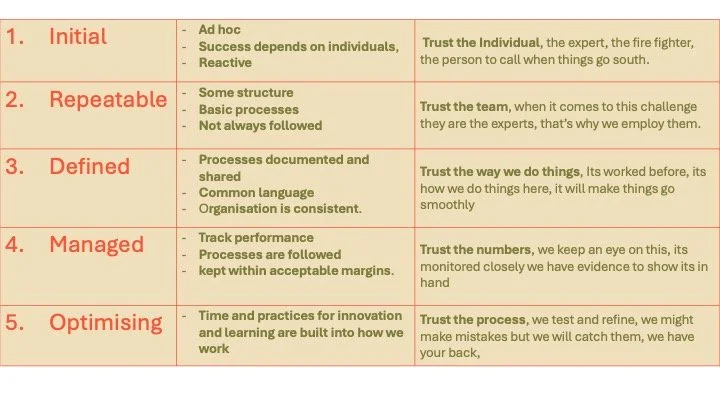
Maturity of trust
Why is getting to Level 3 so hard?
The observant among you will notice that Level 3 echoes the classic description of organisational culture: “how we do things around here”.
Trusting that the way things happen is right — and that it is right across the whole organisation — means that organisations seeking to mature, and organisations seeking to implement strategy, need to understand that this is culture work.
More specifically, it is the work of creating a more trustworthy culture.
This is why reaching Level 3 is so hard. At other levels, you can often address maturity uplift directly within the system. At Level 3, much of the work happens around the system: in leadership behaviour, cross-team relationships, communication, role clarity, learning, and follow-through.
As the team at Neu21 puts it:
“Culture is like a shadow. You can’t grab a shadow. A shadow is a reflection of the reality.”
The work required to reach Level 3 maturity happens around the system, rather than in the system.
Is it worth it?
Earlier, I said that most organisations I have worked with operate predominantly at Level 1 or Level 2, with notable sector-driven exceptions such as finance teams. I have also argued that the barrier between Level 2 and Level 3 is significant. It is a cultural shift.
So, is it worth the effort?
Ultimately, that is a question for the leadership of each organisation. I think it is worth it. When Level 3 or above becomes normal, some useful things begin to happen:
Teams often enjoy their work more because they spend less time navigating avoidable ambiguity and inconsistency.
Staff can operate in safer physical and psychological environments.
Organisational efficiency increases, saving time, effort, and other resources.
Interoperability between teams improves and silos become less entrenched.
Decision-making becomes responsive without becoming reactive.
Investing in mature systems takes significant work, and it asks most of us to work differently from how we are used to working. But the benefits are real for organisations that decide to take this path. The first step is accepting that trust is not a nice-to-have. It is foundational to even a moderately mature organisation.
The good news is that building a culture of trust is fairly simple.
The bad news is that simple does not mean easy.
