Sometimes the middle is the place to be
Maturity Models part 6.
On my first day working at the Department of Conservation, my boss walked me around the office and explained the expectations, the emergency exits, and all the standard day-one malarkey.
But two things stood out.
I was told that there were two things done the same way everywhere at DOC:
Meetings ran using Team Process.
Tasks were issued using Task Assignment.
At the time, this organisation-wide approach struck me as interesting. Only in retrospect have I come to understand how profound a difference it made to the day-to-day operation of an organisation charged with administering around one-third of New Zealand’s land and waters. These systems were right in the middle of the maturity levels, and they were working fantastically.
Team Process
When a meeting was organised at DOC, a default agenda was built in. Every staff member completed training so that they could both lead and contribute to meetings. Regardless of which team you joined, if you were invited into a meeting, you entered the room knowing broadly what to expect. The approach was simple. In every office, and on almost every desk, you could find a version of Team Process like the one below.
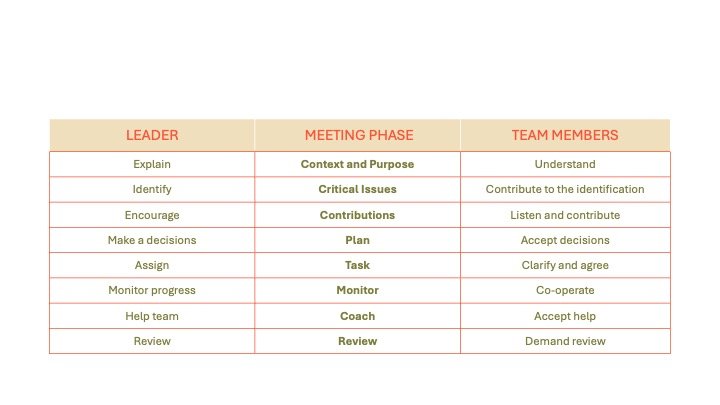
Roles and Phases of Team Process
Task Assignment
The midway step of Team Process is “Task”. This is where we used Task Assignment. Task Assignment was a standardised approach to briefing work: within a team, across a group, and from the top of the organisation through to the front line.
Its central purpose was to create a “clean ticket of work”. In other words, when you gave someone a piece of work, it came with enough information and resources for them to apply their judgement and take accountability for delivering it.
Task Assignment created shared understanding between the person giving the task and the person receiving it about and was split into the following sections:
Purpose
Context
Quantity of output
Quality of output
Resources, such as budget, people, and equipment
Time
The value of Level 3
Team Process and Task Assignment created a smoothness of work at DOC. The shared approach and common language allowed for a speed of communication that seldom happens in organisations of that size. While I worked there, it felt like “how we do things around here”. In other words, it was part of the culture of the organisation.
Both Team Process and Task Assignment are useful examples of systems operating at Level 3 maturity:
“Processes are documented, shared, and used across the organisation. People know what to do and how to do it, there is a common language, and work across the organisation is consistent.”
Team Process and Task Assignment are not the only ways to run meetings or brief work. Many people could make a strong case that they are not even the best ways. But at DOC, during my time there, they were consistent. The value of that consistency showed up every day in faster communication across teams, reliable delivery of work, and clarity of expectations. These were small moments that removed a source of frustration and lowered one part of the cognitive load caused by all to common aspacts of working in a large organisation.
Level 3 and cost
From the perspective of organisational cost. the time, effort, and money required to run a system, Level 3 is often the sweet spot.
For systems that benefit from organisation-wide consistency, Level 3 can be the lowest ongoing-cost point on the maturity curve.
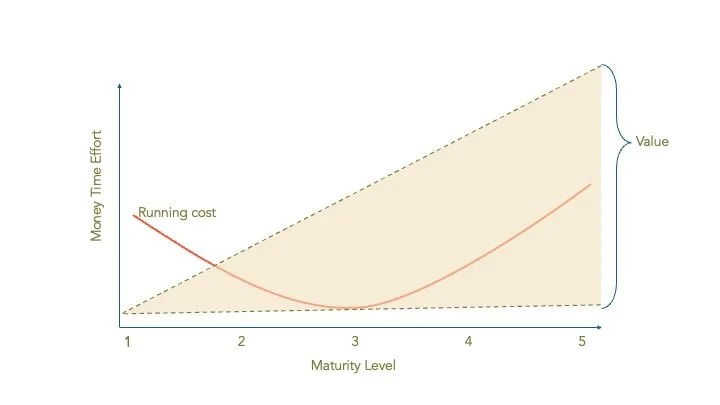
Cost of running a system vs value delivered at each level of maturity
As a general rule, the average ongoing cost of running a system often falls from Level 1 to Level 3. As a system becomes more regular, moving from ad hoc work, to a team using a repeatable approach, to an organisation-wide shared approach, the churn associated with delivering that work falls.
From Level 3 to Level 5, costs start to climb again. At Level 4, we introduce the work of management: creating regular reports, reading them, and responding to them. At Level 5, we add the time required for innovation, experimentation, reflection, and continuous improvement.
This does not mean Level 3 is always the right destination. It does mean we need to become more intentional about how we consider the value delivered by our systems. The appropriate level depends on the system, its purpose, its risk, the pace of external change, and the value created by additional management or optimisation, not to mention how much capacity you have to focus on change and improvement.
But for many systems, Level 3 is where consistency produces substantial value without requiring the full cost of formal measurement and continual optimisation. It is a good rule of thumb to aim for Level 3. Incidentally, the biggest reason behind me choosing to use the CMM maturity model as the basis for my approach is because of the value that comes from consistency, by using a framework that is well established I can stand on the shoulders of giants, and better see the implications that emerge from using this approach.
Reason to Select Each Maturity Level
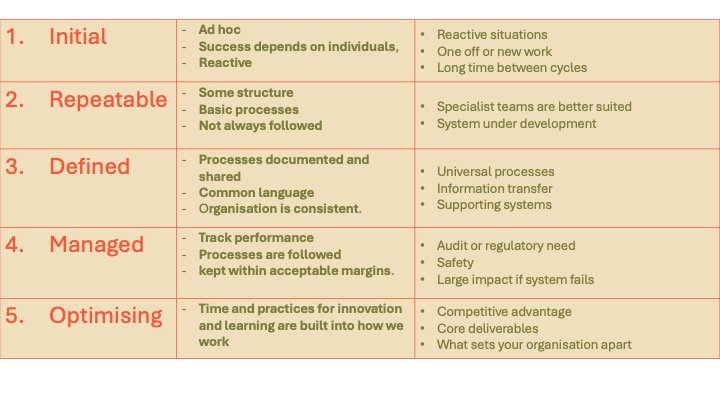
Aiming for Level 5 for everything is silly
Three is the magic number
In my previous post on trust, I asked: “Is it worth it?” By that, I meant: is the effort required to mature systems worth the investment? Creating the environment that allowed Team Process and Task Assignment to work required a huge amount of effort over several years. But once those ways of working were established, they kept running.
They would have saved the organisation money every time someone needed to give another person work to deliver. They reduced confusion in meetings because the purpose for being there was clear. And every time a meeting was called at short notice to deal with the latest emergency, there was no time wasted setting the agenda: we could simply run Team Process.
The beautiful irony of Level 3 systems is that much of their value is intuitive. We do not subject them to the same exacting measurement and reporting as Level 4 systems, yet they quietly sit in the driver’s seat, steering the organisation strategy delivery, while nobody is looking.
So, is it worth investing the time and effort needed to reach Level 3?
It is, if you want your organisation to know whats sitting behind the wheel steering the outcomes of the organisation.
